You’ve tried eating well. You exercise regularly. But the fat on your legs just won’t budge — and it’s starting to hurt. If that sounds familiar, you might not be dealing with regular weight gain at all. What you’re experiencing could be lipedema, a chronic condition that behaves very differently from normal fat — and requires a completely different approach.
In this guide, we break down exactly what sets lipedema fat apart from normal fat, what symptoms to look for, and what treatment options are available in the UAE. The UAE, particularly Dubai and Abu Dhabi, is recognized as a global center for cosmetic and medical procedures, making proper diagnosis and specialized treatment easier than ever.
What is Normal Fat?

Normal fat responds directly to diet and exercise, accumulating when calorie intake is high and reducing with a calorie deficit. Unlike lipedema, excess normal fat is usually distributed across the body, does not cause physical pain, and remains soft to the touch.
Read also about lipedema dubai
Book An Appointment
What is Lipedema Fat?
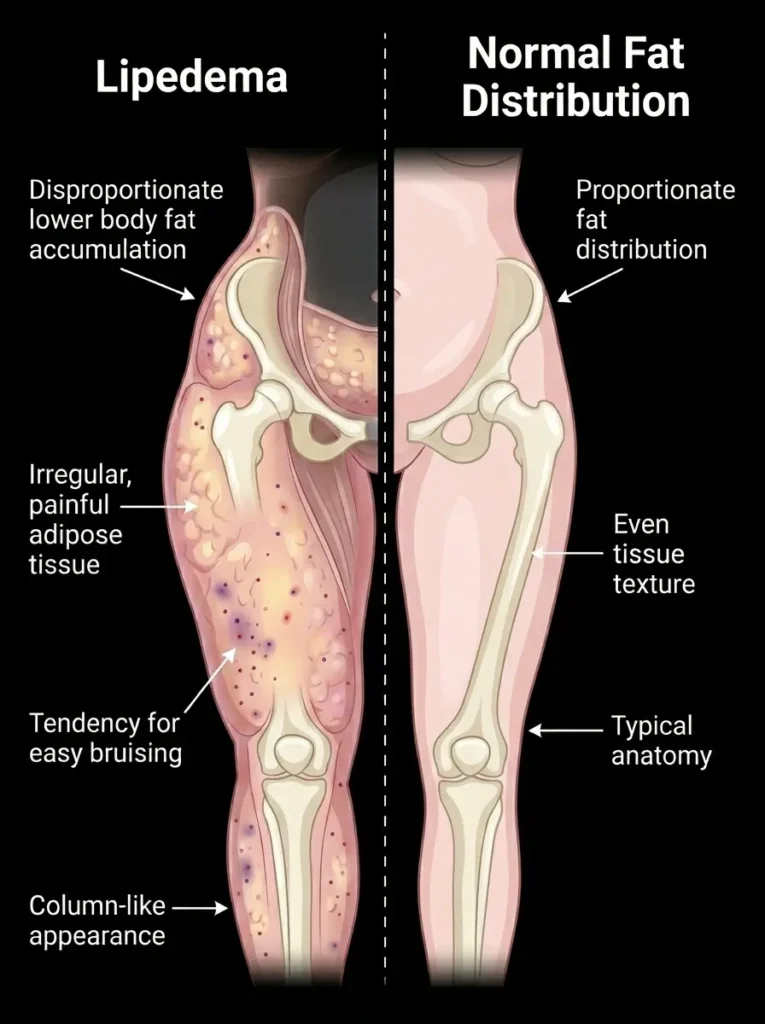
Lipedema is a chronic, progressive condition that almost exclusively affects women. It typically develops or worsens during hormonal shifts — puberty, pregnancy, or menopause. Unlike normal fat, lipedema fat builds up in a very specific pattern: it accumulates symmetrically in the lower body (hips, thighs, and calves) while almost always sparing the feet, creating a clear “cuff” at the ankle.
Unlike regular fat, lipedema fat hurts. It’s tender to the touch, feels heavy, and leaves many women exhausted by the end of the day. In more advanced stages, it can significantly limit movement and quality of life.
Doctors don’t fully understand why lipedema develops, but research strongly points to hormonal triggers and genetic predisposition. If your mother or sister has it, your risk is significantly higher.
Learn about: lipedema vs lymphedema
Lipedema Fat: Key Differences from Normal Fat
Here is an overview of the key differences that clearly distinguish lipedema fat from normal fat:
Feature | Normal Fat | Lipedema Fat |
Responds to diet/exercise | Readily responds to a calorie deficit, a healthy diet, and regular exercise programmes. | Highly resistant to diet and exercise; calorie restriction does not reduce this specific fat. |
Texture | Soft, smooth, and uniform when touched or palpated. | Nodular, bumpy, or grain-like under the skin. |
Swelling | Does not cause fluid retention or swelling in the affected areas. | Frequently associated with fluid retention and swelling, which worsens during the day. |
Symmetry | Distributed relatively evenly and symmetrically across the whole body. | Typically, accumulating equally on both legs or arms, but completely sparing the hands and feet. |
Pain | Completely painless to the touch and does not cause physical discomfort. | Painful, tender to pressure, aches easily, and is highly prone to bruising |
Position | Can accumulate anywhere on the body, including the abdomen, face, and chest. | Primarily confined to the lower body (hips, buttocks, and legs) or the upper arms. |
Treatment options for Lipedema fat vs normal fat
For Lipedema Fat
Conservative Treatments
Conservative management focuses on controlling symptoms and slowing progression. This typically includes wearing medical-grade compression garments to reduce swelling and pain, combined with regular Manual Lymphatic Drainage (MLD) sessions to stimulate circulation and ease discomfort. While conservative care won’t eliminate the fat itself, it can make a meaningful difference in daily comfort and mobility.
Surgical Treatments
For many women, surgery is the most effective long-term solution. Specialised lipedema liposuction—using techniques like water-assisted or tumescent liposuction—is specifically designed to remove the diseased fat cells without damaging the lymphatic system. Crucially, this is not standard liposuction; it must be performed by surgeons who specialize in the unique structure of lipedema tissue. Patients often experience significant pain reduction and improved mobility immediately, with the most proportionate body shape changes becoming visible over the following months. Many patients in the UAE report life-changing outcomes after their first procedure.
For Normal Fat
Diet and exercise
For normal fat, a consistent combination of regular exercise and a calorie-controlled diet is the most effective approach. With the right programme, your body will naturally burn excess fat over time.
Surgical treatment for stubborn fat
For those dealing with stubborn, localised fat that just won’t respond to lifestyle changes, cosmetic procedures offer a faster path to results. Traditional liposuction or non-invasive fat-reduction treatments are widely available across the UAE and can be an excellent option for targeted body contouring.
Understanding the difference between lipedema and normal fat isn’t just academic — it’s the first step toward getting the right diagnosis and the right treatment. If you’ve been struggling with painful, treatment-resistant fat in your legs or lower body, you deserve answers.
At our clinic in Dubai, we specialise in diagnosing and treating lipedema using the latest surgical and non-surgical techniques. Our team has helped hundreds of women across the UAE finally get the relief they’ve been looking for.
Ready to find out if what you’re experiencing is lipedema? Book a consultation today and take the first step toward a life with less pain and more confidence.