
The surgery is booked, your surgeon has answered the questions about scars and technique, and now a far more practical worry has taken over: how many days will you actually be out of action? Nobody schedules an operation in a vacuum — there is work, there are school runs, there is a gym membership you would rather not waste. Brachioplasty recovery is predictable enough to plan around once you know the shape of it. So what happens in the first three days, when can you drive, and when do you get your arms back?
Brachioplasty recovery at a glance

Stage | What is happening | What you can do |
|---|---|---|
Days 1–3 | Swelling and bruising peak at 36–48 hours; drains may be in place | Rest, arms elevated and below shoulder level |
Days 3–7 | Drains come out; first dressing check around day five | Shower, then straight back into the garment |
Weeks 1–2 | Bruising fades; compression worn around the clock | Desk work; driving from about day ten |
Weeks 3–6 | Overhead reaching comfortable; most swelling gone | Light cardio from weeks three to four |
Weeks 6–8 | Full normal activity restored | Weights reintroduced, starting very light |
Months 9–18 | Scar flattens, softens and fades | Silicone and strict sun protection |
Book An Appointment
What happens in the first 72 hours after an arm lift?
This opening phase of brachioplasty recovery is the most restricted, and also the shortest:
- What you wake up to: arms wrapped in a compression garment, sometimes with small drains, depending on how much tissue was removed.
- Swelling and bruising: peak within the first 36 to 48 hours, then begin to settle.
- Pain: tightness rather than sharp pain, controlled with oral medication and easing noticeably after that 48-hour mark.
- Positioning: arms below shoulder level and propped on pillows.
- Supervision: arrange for an adult to stay with you for the first 24 hours.
Learn about: brachioplasty dubai
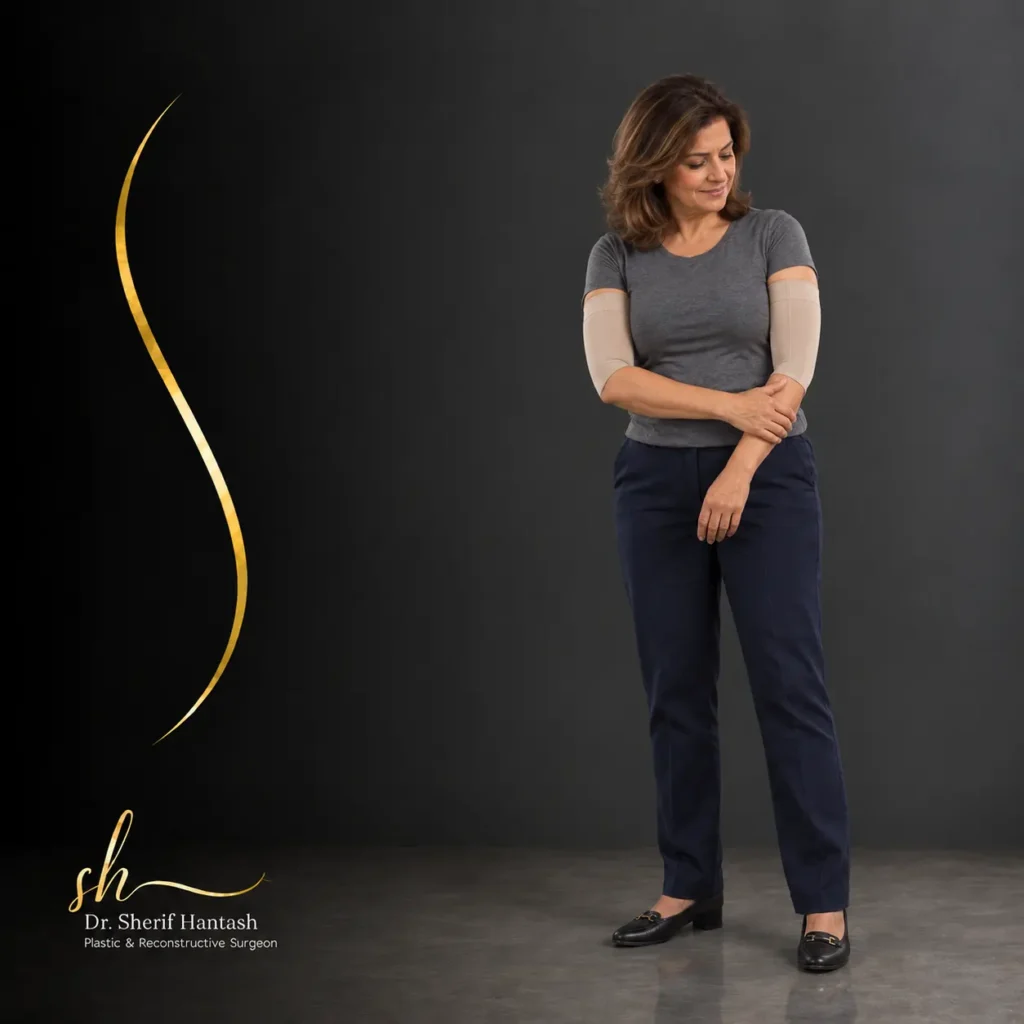
What do weeks one and two look like?
From here, brachioplasty recovery is largely a matter of patience and compression:
- Drains out: usually between days three and seven.
- First dressing check: around day five — you can shower afterwards, then go back into the garment.
- Compression: around the clock at this stage, off only for bathing.
- Back to work: one to two weeks for most desk jobs.
- Driving: generally cleared around day ten, provided you are off strong painkillers.
- Sleeping: arms elevated on pillows for the full fortnight.
When can you lift, reach and train again?
Weeks three to six are where arm lift recovery starts to feel like progress rather than management. Compression usually drops to daytime wear, and most swelling resolves by weeks three to five — though residual puffiness can linger for months and is entirely normal.
Activity | Typical clearance |
|---|---|
Brisk walking, stationary bike | Weeks 3–4 |
Reaching overhead comfortably | Weeks 3–6 |
Exercise that directly stresses the arms | After about 4 weeks |
Heavy lifting, jogging, contact sport | After 6 weeks |
Upper-body weights | 6–8 weeks, starting very light |
Those are typical windows, not promises — your surgeon sets the pace of your own brachioplasty recovery.
How do you look after the scar?
The arm feels normal long before it looks finished, and this is the stage that tests most people’s patience. Two things genuinely help:
- Silicone gel or sheeting: started once the wound is fully closed, this is the best-evidenced measure you can take at home.
- Sun protection: ultraviolet light on an immature scar drives lasting pigmentation, which matters more in the Gulf than almost anywhere.
Expect the scar to darken or thicken around the third or fourth month before it improves. That is a normal part of healing, not a sign something has gone wrong.
What slows brachioplasty recovery down?
Most setbacks surgeons see are not bad luck; they are avoidable, and they cluster around a short list:
- Smoking and nicotine: constricted blood supply is the main driver of delayed healing and skin necrosis — about 2.3% of cases.
- Skipping compression: the garment discourages fluid collecting under the skin; seroma affects around 5.9% of patients.
- Doing too much too soon: tension across a fresh incision is how wound breakdown happens — roughly 6.8%.
- An unstable weight: gaining or losing significantly afterwards undoes the result — recurrent sagging in about 7.8%.
- Heat, humidity and early swimming: a Dubai summer and an unsealed wound are a poor combination; infection sits near 3.6%.
Technique matters too: in one study, liposuction-assisted brachioplasty produced minor complications in 9% of patients against 60% for standard excision alone. |
Learn more about:
Which symptoms mean you should call your surgeon?
Most of brachioplasty recovery is uneventful, but a short list of warning signs is worth memorising rather than searching for at 2am. Call your clinic if you notice:
- Pain that increases after the first 48 hours instead of easing
- A fever
- Sudden swelling in one arm, or redness spreading from an incision
- Foul-smelling discharge from a wound
- Calf pain or breathlessness
- Numbness along the inner arm that worsens rather than settles
Some altered sensation is expected — nerve complications occur in roughly 2.5% of cases and are usually temporary — but anything on that list warrants a phone call rather than a wait.
Planned properly, brachioplasty recovery costs you about two weeks of normal life, six weeks of the gym, and a year of watching a scar improve. Book the time off before you book the surgery, buy a second compression garment so one is always clean, and be honest with your surgeon about how much rest you can realistically take.
Learn more about: Arm lift surgery dubai
Frequently Asked Questions About Brachioplasty Recovery
When can I raise my arms above my head?
Keep them below shoulder level for the first week or two. Overhead reaching usually becomes comfortable during weeks three to six, but follow your own surgeon’s instruction.
How long is brachioplasty recovery time in total?
Expect one to two weeks off desk work, six weeks before full normal activity including exercise, and nine to twelve months for the scar to mature.
How long do I wear the compression garment?
Around the clock for the first two weeks apart from bathing, then daytime wear for several weeks more, commonly to the six-week mark.
When can I fly after an arm lift?
Most surgeons want your drains out and your first post-operative check done first, and ask you to move about the cabin.
Can I speed up arm lift recovery?
Not really, but you can avoid slowing it: no nicotine, wear the garment, keep your weight stable, sleep elevated, and let your surgeon set the pace of brachioplasty recovery rather than your own impatience.
Recovery goes best when the plan is agreed before the operation, not improvised after it. Dr Sherif Hantash, a DHA- and DOH-licensed consultant plastic surgeon in Jumeirah with more than 15 years of experience and over 5,000 procedures performed, takes patients through the full brachioplasty recovery schedule at consultation. Book an appointment to plan yours around your life.