
There is a particular kind of frustration in getting dressed when your arms will not cooperate. Sleeves that fit everywhere else grip at the upper arm. A hand on your shoulder makes you flinch. Bruises appear along the back of the arm and you cannot account for a single one.
And when you lose weight, your face and waist change while your arms stay stubbornly the same. If that pattern sounds familiar, ordinary arm fat may not be the explanation — lipedema arms behave in a very specific way, and once you know what to look for it is surprisingly recognisable.
What does it actually look like?

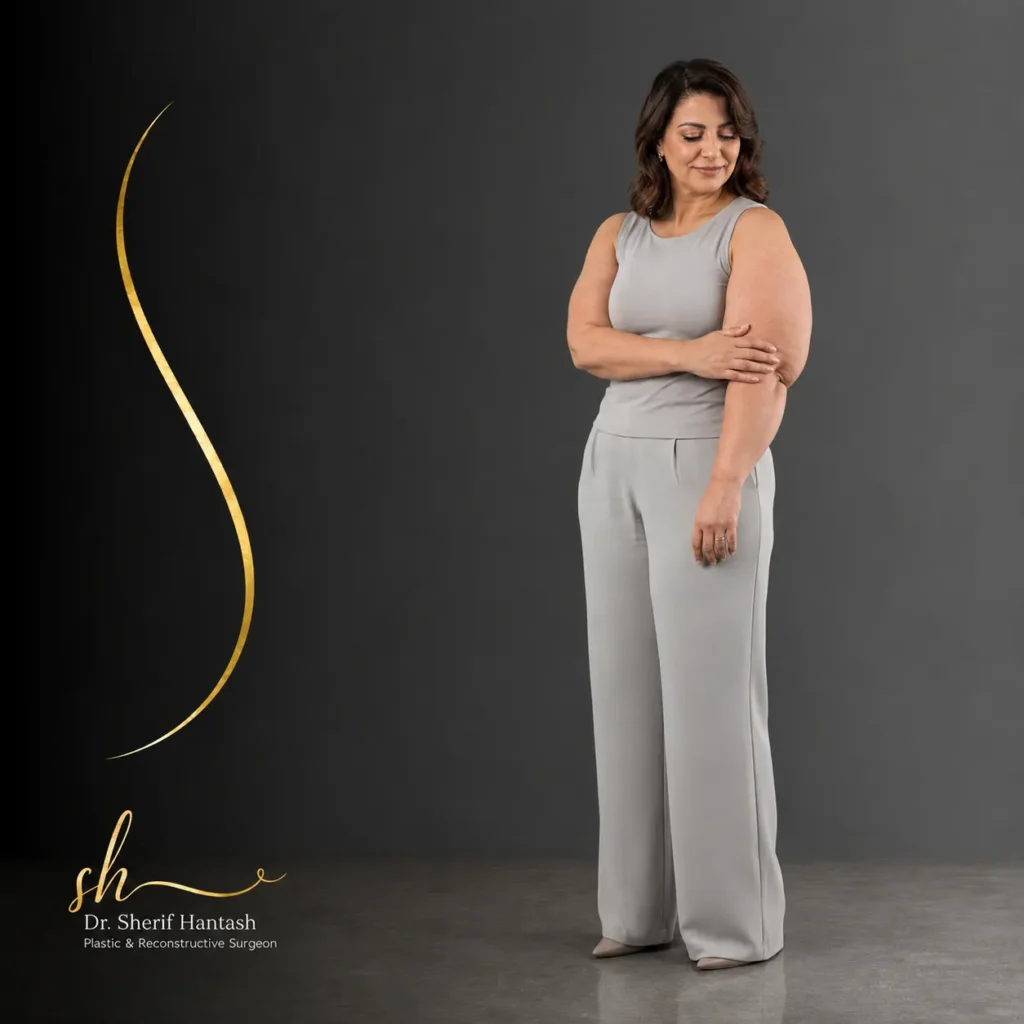
The single most useful clue is symmetry: the tissue increases on both arms in almost the same way, rather than one being noticeably larger. It is also common — nearly 80% of women with lipedema have affected tissue on the upper limbs, according to the Lipedema Foundation. The pattern varies:
- Upper arm only: the most frequent presentation, often with a ridge of fat sitting above the elbow.
- Upper and lower arm together: the next most common.
- Forearm alone: rare in practice.
- The hands are spared: the swelling stops abruptly at the wrist, leaving a visible cuff. That sharp cut-off is one of the clearest signs you are not simply looking at weight gain.
In most women, lipedema arms appear alongside the same tissue changes in the legs.
Read also about lipedema dubai
Book An Appointment
How do you know it is not just arm fat?
This is where the symptoms, rather than the shape, do the identifying — and with lipedema arms the pain is what sets it apart:
- Tenderness out of proportion to the pressure — a light touch or the seam of a sleeve can hurt, and pain ranges from a dull constant ache to sharp episodes.
- A positive pinch test: gently pinching the skin of the upper arm causes unusually severe pain.
- Easy bruising, often with no remembered knock.
- Heaviness and fatigue in the arms by the end of the day.
- An orange-peel or dimpled surface as the condition progresses.
- Fat that does not respond to weight loss when the rest of the body does.
Ordinary excess fat is smooth to press, not painful, and shrinks when you lose weight. Any two or three of the signs above together are worth taking to a clinician — our guide to lipedema diagnosis explains how the assessment is carried out.
Learn about: lipedema specialist
Why does it develop?
Honestly, the full mechanism is not yet settled, and any source that tells you otherwise is overstating the science. What the evidence does support is a combination of two things:
- Genetic predisposition: it frequently runs in families, and a similar body shape among female relatives is one of the strongest clues in the history.
- Hormonal change: onset and worsening cluster around puberty, pregnancy and menopause, which is thought to explain why lipedema arms and legs develop the way they do.
What is clear is what does not cause it. This is not the result of overeating or inactivity — and treating it as though it were is precisely why so many women spend years being told to try harder.
Learn more about lipedema vs lymphedema
Are the arms staged like the legs?
Not officially, and this catches people out. Although clinicians once assigned stages to the arms as well, the prevailing standard today is to stage the condition on the legs alone.
The tissue changes in the arms do follow a comparable progression — smooth skin with soft, enlarged tissue early on; an uneven, dimpled surface with larger palpable nodules as it advances; and eventually lobules that alter the shape of the upper arm. Lipo-lymphedema, where lipedema and lymphedema occur together, can also develop in the arms, and lymphedema can be present at any stage.
Where staging genuinely matters is this: pain and mobility do not track it neatly, so mild-looking lipedema arms can still hurt a great deal.
Learn more about:

What treatments actually help?
Treatment for lipedema arms splits cleanly into two categories, and confusing them is the source of a lot of disappointment. Conservative measures manage symptoms; surgery is the only approach that removes the tissue itself:
- Compression: sleeves and armbands limit swelling and ease pain, though in practice arm compression is needed far less often than leg compression.
- Manual lymphatic drainage and physiotherapy: stimulate lymph flow, reduce heaviness, and help with pain and mobility.
- Movement and nutrition: regular exercise and an eating pattern aimed at inflammation support the rest of the plan, though no diet has been proven to reverse the condition.
- Liposuction: the only treatment that permanently removes the affected fat, performed with lymph-sparing instruments and technique to protect the lymphatic vessels running through the tissue.
International guidelines recommend trying conservative therapy before a surgical referral — and the two work best together, with liposuction alongside drainage, movement and sensible nutrition rather than instead of them.
What can you expect from surgery?
Surgeons who operate on lipedema arms regularly report consistently good outcomes, both in pain reduction and in the shape and mobility of the arm. For many patients the relief from tenderness matters more than the contour.
That said, expectations should be set honestly:
- More than one operation is often required.
- Results vary between patients.
- Reported complications include prolonged swelling after surgery and regrowth of affected tissue in areas that were not treated.
- Recovery involves compression and a phased return to activity, with swelling taking months rather than weeks to settle.
None of this is a reason to avoid surgery. It is a reason to have the conversation with someone who does this work often.
What tends to change everything for women living with lipedema arms is not a new product but a correct name for what is happening. Once the tissue is identified for what it is, the pain stops being something you have to justify, and the plan stops being another diet. Our guide to choosing a lipedema specialist explains who is qualified to confirm it.
Learn about:
Frequently Asked Questions About Lipedema Arms
Can you have it in the arms but not the legs?
It is possible, but uncommon. The arms are affected in nearly 80% of women with the condition, and they are usually involved alongside the legs rather than on their own.
Does the pinch test confirm the diagnosis?
No. Severe pain when the skin of the upper arm is gently pinched is a strong pointer, but the diagnosis is made from your full history and a proper clinical examination.
Will losing weight reduce it?
Weight loss usually changes the unaffected areas while lipedema arms stay much the same. That mismatch is one of the condition’s most recognisable features, and it is not a sign that you did anything wrong.
Is arm liposuction different from cosmetic arm liposuction?
Yes. The technique is adapted to protect the lymphatic vessels within the tissue, the volumes involved are usually larger, and the primary aim is pain relief and mobility rather than contour alone.
Do I need to wear compression sleeves for life?
Not necessarily. Arm compression is required far less often than leg compression, and your clinician will decide based on your symptoms and how the tissue behaves after treatment.
If your arms hurt in the way described here, the next step is an examination for lipedema arms by someone who palpates the tissue rather than glancing at it. Dr Sherief Hantash, consultant plastic surgeon in Dubai, assesses upper-limb involvement as part of his body contouring practice and will talk you through conservative treatment, the realistic outcomes of lymph-sparing liposuction, and which of them your case actually calls for.