
You have lost weight before. Your face changed, your waist changed, and your legs stayed exactly as they were — heavy, tender to the touch, bruising from knocks you do not remember.
Somewhere along the way a doctor told you to try harder, and you believed them, because that is what you had been told since you were fifteen. If that is your history, the missing piece may not be willpower at all. It may be a lipedema diagnosis that nobody has thought to make. So what is the doctor actually looking for, and what should you expect at the appointment?
Why is it missed so often?

Because there is no blood test and no scan that returns a yes or no. Lipedema is a clinical diagnosis — it rests entirely on a careful history and a pair of experienced hands, and in a fifteen-minute appointment those are exactly the things that get skipped.
The condition is also far from rare. The European Reference Network on rare vascular diseases has estimated that around 11% of women worldwide may be living with undiagnosed lipedema, yet it barely features in most medical training.
The result is predictable: the fat gets labelled as simple obesity, the patient is sent away with diet advice, and published studies report average delays running from several years to more than two decades before a lipedema diagnosis is finally made. Knowing what should happen at the appointment is the fastest way to shorten that wait.
Read also about lipedema specialist
Book An Appointment
What will the doctor ask about?
The history carries more weight in a lipedema diagnosis than in almost any other condition, so expect the questions to range wider than you might assume:
- Whether close female relatives share the same body shape — it tends to run in families.
- Whether the affected areas resist diet, exercise and even bariatric surgery, while the rest of the body responds normally.
- Whether it started or worsened around a hormonal shift: puberty, pregnancy or menopause.
- Pain, tenderness and a feeling of heaviness in the affected limbs.
- A tendency to bruise from minor contact.
- Fatigue, brain fog, joint problems, and reduced mobility or quality of life.
- Whether elevation and diuretics fail to make any real difference — they usually do fail, which is itself a clue.
Learn about: lipedema arms
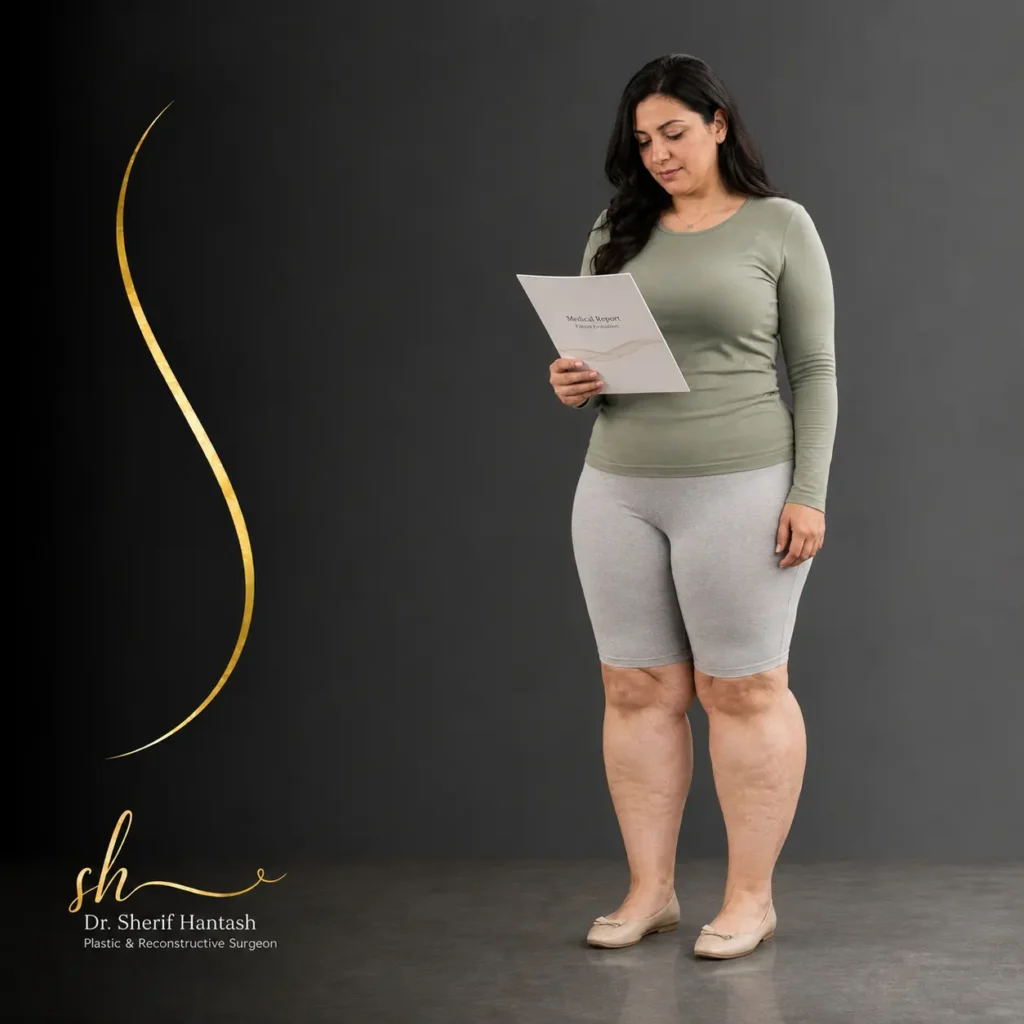
What happens during the physical examination?
Once the history points in the right direction, the examination is what confirms a lipedema diagnosis. It comes in two halves — looking, then feeling. Visually, the clinician checks for:
- Fat built up on both sides symmetrically across the legs, hips, buttocks, lower trunk and often the arms.
- A clear disproportion between the upper and lower body.
- Lobules of fat at the hips, the inner knees or above the elbows.
- A raised “cuff” where the swelling stops abruptly at the wrists and ankles.
- Spider veins or varicosities.
By palpation, they are feeling for texture and tenderness. Lipedema tissue is described as nodular — grains of rice, peas, or walnut-sized lumps — sometimes with dense, fibrotic or stringy areas, and the skin over it can feel cooler than surrounding tissue. Pain on gentle pressure is a hallmark of a lipedema diagnosis, not an incidental finding.
Because the arms are involved in a large share of cases, they should be examined too. Our guide to lipedema arms covers what that looks like specifically.
Learn more about:
What is the Stemmer sign, and what does it tell you?
It is a ten-second test with a surprisingly large role in the process. The examiner tries to pinch and lift a fold of skin on the top of the foot at the base of the second toe, or the equivalent spot on the second finger:
- The skin lifts (negative sign): lymphedema is unlikely. This is the usual finding in lipedema, because the condition characteristically spares the hands and feet.
- The skin will not lift (positive sign): lymphedema is likely present.
Importantly, a positive Stemmer sign does not cancel a lipedema diagnosis. It usually means both conditions are present together — a combination termed lipo-lymphedema.
Learn more about:
How is it told apart from obesity and lymphedema?
This is the crux of the whole assessment, and three distinctions do most of the work in reaching a lipedema diagnosis:
- Versus obesity: fat from obesity is distributed relatively evenly, feels smooth, is not painful to press, and shrinks when you lose weight. Lipedema fat is disproportionate, nodular under the fingers, painful, and stubbornly unchanged by weight loss.
- Versus lymphedema: lymphedema typically affects one limb rather than both, involves the foot or hand, and produces a positive Stemmer sign. Lipedema is symmetrical and stops at the ankle or wrist.
- They are not mutually exclusive: a woman can carry excess weight and have lipedema — which is precisely why so many are given the first label and never a lipedema diagnosis.
Learn more about:
What do the stages mean?
Staging describes how the tissue has changed over time, and by current convention it is assessed on the legs:
- Stage 1: skin still looks smooth, with enlarged fat underneath that feels soft, sometimes with small nodules like rice or pearls beneath the surface.
- Stage 2: the surface becomes uneven — dimpled, wavy, orange-peel or mattress-like — with larger nodules, walnut to apple sized. The fat may be thickened and fibrotic.
- Stage 3: large lobules and overhangs distort the shape of the thighs and knees, with widespread nodularity and fibrosis.
- Lipo-lymphedema: lipedema and lymphedema together. Once called “stage 4”, the label has been dropped by the Lipedema Foundation, since the lymphatic system can be affected at any stage.
One caveat worth carrying into your appointment: these stages describe appearance, not suffering. Pain, mobility and quality of life do not track them neatly, so a stage 1 result does not mean your symptoms are minor.
Learn more about:
Will you need a scan?
Possibly, but not to prove the condition — imaging is not what delivers a lipedema diagnosis. Ultrasound, MRI, CT and lymphatic imaging are ordered mainly to exclude other explanations for a swollen limb, such as venous disease or lymphatic obstruction.
Imaging is an active research area, with work under way on tissue sodium MRI, ultrasound measurements of fat layer thickness and 3D surface scanning. It may well contribute to a definitive test in future. For now, the diagnosis is made by a clinician who knows what they are looking for.
If any of this reads like your own medical history, the useful next step is not another diet — it is an appointment with someone who examines the tissue rather than the scale. Our guide to choosing a lipedema specialist explains which professions actually make the diagnosis.
Frequently Asked Questions About Lipedema Diagnosis
Is there a blood test for lipedema?
No. A lipedema diagnosis is clinical, based on your history and a physical examination. Blood tests and scans are used to rule out other conditions, not to confirm this one.
Can you have lipedema and obesity at the same time?
Yes, and it is common. The two frequently coexist, which is one of the main reasons the condition is overlooked — the visible weight gets treated and the painful, nodular, diet-resistant fat is never separately identified.
Does lipedema affect men?
It almost exclusively affects women, which is thought to reflect the role of hormonal changes. Cases in men have been documented but are rare.
How can I prepare for the appointment?
Bring photographs of yourself over the years, a note of your weight history and what treatments you have tried, any family photos showing a similar body shape, and a short description of your pain and bruising. This history is what the assessment is built on.
Does a diagnosis mean I will need surgery?
Not automatically. A lipedema diagnosis opens a range of options rather than pointing straight to theatre. International guidelines recommend conservative treatment first — compression, manual lymphatic drainage, movement and nutrition — with surgery considered afterwards for patients who need it.
If you would like the examination done properly, by someone who works with this tissue regularly, Dr Sherief Hantash, consultant plastic surgeon in Dubai, offers the full clinical assessment a lipedema diagnosis requires: history, palpation, staging, and a frank conversation about what conservative care and surgery can and cannot achieve in your case. Getting an answer after years without one changes more than the treatment plan.